
Toddler Climbing Out of the Crib: Safe Next Steps by Age
Why toddlers climb out of the crib, the AAP’s height rule for moving to a bed, and how to make the room safer for a climber, stage by stage.

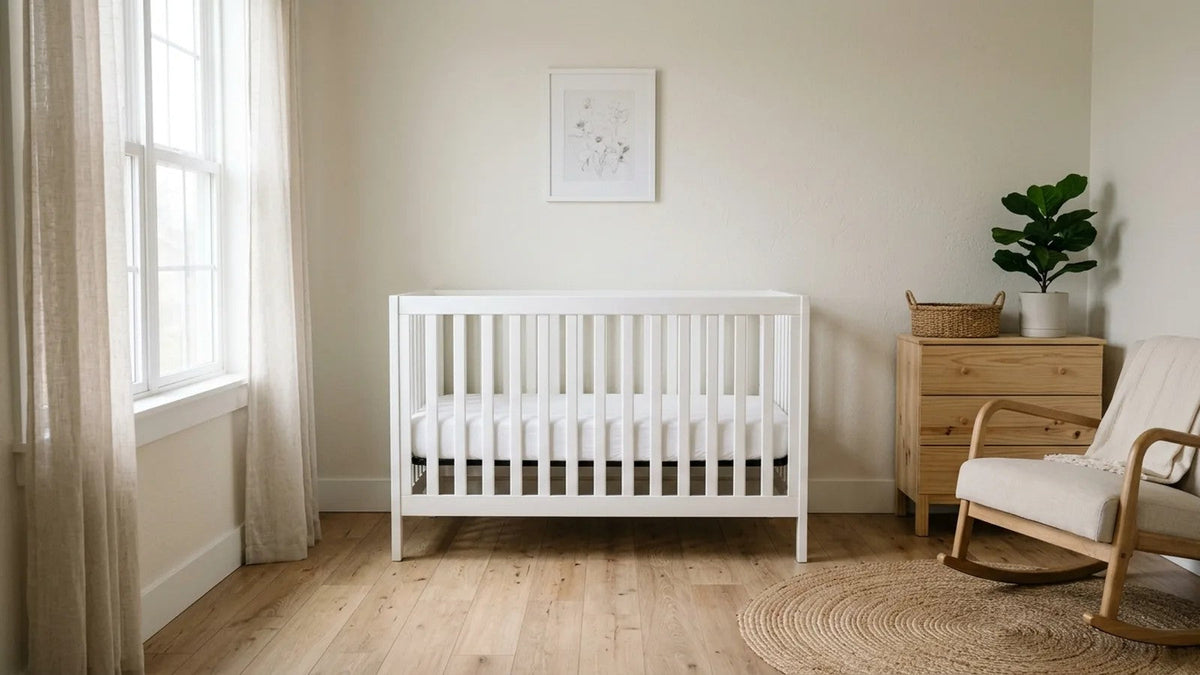
A toddler climbing out of the crib is a fall risk. The AAP says to lower the crib mattress before your baby sits and again before your baby stands. The AAP’s signal to move to a bed is size: your child is 35 inches (89 cm) tall, or the side rail is less than three-quarters of your child’s height (approximately nipple level). None of these steps replaces watching your child.
Why a Toddler Climbing Out of the Crib Is a Fall Risk
The AAP’s HealthyChildren.org says falls are the most common injury associated with cribs. It also says the most common falls happen when a baby tries to climb out. According to the AAP, children are most likely to fall when the mattress is raised too high for their height, or when it is not lowered properly as they grow.
NICHD, citing the CDC, reports that falls are the most common cause of nonfatal injuries for children ages 0 to 19.
Picture this: it is 5 a.m., you hear a thump down the hall, and your toddler is standing outside the bedroom door. The crib is behind them, and you did not see how they got out. A moment like that is why mattress height and crib condition matter long before the first climb.
Safe Next Steps by Age and Stage
The AAP ties the mattress steps to what your baby can do, not to a birthday. Before your baby can sit, the AAP says to lower the crib mattress to the level where your baby cannot fall out, either by leaning against the side or by pulling himself over it.
For timing, the CDC lists "Sits without support" and "Gets to a sitting position by herself" among its milestones by 9 months. The CDC says milestones are things most children (75% or more) can do by a certain age. The AAP’s rule follows the skill, not the birthday.
The next step comes before your child learns to stand. The AAP says to set the mattress at its lowest position by then. The CDC lists "Pulls up to stand" and "Walks, holding on to furniture" among its milestones by 1 year.
The AAP and CDC pages give no age for climbing out. The AAP ties the move out of the crib to size instead. It says to move your child to another bed when they are 35 inches (89 cm) tall, or when the height of the side rail is less than three-quarters of their height (approximately nipple level). The AAP’s Big Kid Beds page adds that once your toddler can climb out of their crib, it may be time to transition to a "big kid" bed.
The table below sums up each stage, the step, and who says it.
Next steps by stage
| Stage | What to do | Source |
|---|---|---|
| Before sitting | Lower mattress before baby sits | AAP |
| Before standing | Lowest mattress position before standing | AAP |
| Climbing out or 35 inches | At 35 inches, move to another bed; once climbing out, it may be time | AAP |
| Play yard | Cannot climb out, under 890 mm | CPSC |
Toddler Climbing Out of Crib Solutions: What the AAP Says
The AAP’s main step is the lowest mattress position, set before your child learns to stand. The AAP and CPSC pages cited here describe no trick that stops a determined climber.
What to Keep Out of the Crib
The AAP says not to use bumper pads. Part of the reason is that toddlers can use a bumper guard to help them climb and fall out.
The AAP also says pillows, quilts, comforters, sheepskins, stuffed animals and other soft products should not be placed in a crib.
Check the Crib Weekly
The AAP says to keep all crib hardware tightly in place, because a child’s activity can cause the crib to collapse. Here is what to check on a crib, according to the AAP: before each assembly and weekly after that, inspect it for damage to hardware, loose joints, missing parts or sharp edges.
The AAP says not to use a crib if any parts are missing or broken. It also advises a crib manufactured after June 2011, when the standards banning the manufacture or sale of drop-side rail cribs became effective.
Toddler Climbing Out of a Play Yard or Unzipping a Sleep Sack
The CPSC says play yards provide sleeping and playing accommodation for a child who cannot climb out and is less than 35 inches (890 mm) in height. A child who can climb out falls outside that description. The CPSC says play yard instructions should specify that only the mattress supplied with the play yard be used. CPSC staff advise consumers not to use supplemental mattresses, because they may create a gap and lead to an entrapment hazard.
A sleep sack raises a different question. The AAP says that if you worry your baby will get cold, you can dress them in layers of clothing or use a wearable blanket. Its reason is that soft objects and loose bedding can increase the risk of entrapment, suffocation or strangulation. The AAP says its safe-sleep recommendations are for babies up to 1 year of age.
The AAP and CPSC pages never say a sleep sack keeps a toddler from climbing out of a crib.
Moving to a Bed: The Floor Mattress and the Bedtime Routine
While You Wait for a Bed
The AAP’s Big Kid Beds page says to place the crib mattress on the floor while you wait. It also says to clear away furniture and large toys, like rocking horses, that could injure your child if they fell against them. Add both steps to your toddler bed transition checklist.


After the Switch
A new bed means a toddler can get up whenever they like. After the switch, the AAP suggests keeping the same bedtime routine. If your toddler gets out of bed, it says to calmly and quietly lead them back to bed and keep interactions brief and boring. In the morning, the AAP says to praise them for having stayed in bed all night.
For questions about your child’s sleep space or routine, the AAP’s Big Kid Beds page says to talk with their pediatrician.
Toddler Climbing Out of Crib at Night: Gates and a Proofed Room
Picture this: your toddler climbs out at 2 a.m. while the house is dark and you are asleep. The hallway, the stairs and every piece of furniture are now within reach. The AAP says you may need to install a safety gate across your toddler’s bedroom door to keep them from wandering when you are not awake.
The Mesh Retractable Baby Safety Gate is one option for the bedroom doorway. It mounts with the hardware in its box: brackets, installation screws, anchor screws and drywall screws, with an instruction manual.
Its dual-rotation lock works with one hand. Turn it clockwise to lock and counterclockwise to unlock. The gate is extra-wide, and the full sizing is on its product page. Its own warning says it is not a substitute for adult supervision, and to stop using it immediately if it becomes faulty.

Treat the Room as One Big Crib
The CPSC says furniture, TVs and ranges can tip over and crush young children. It says deaths and injuries occur when children climb onto, fall against or pull themselves up on dressers, shelves, bookcases and TV stands. The CPSC says to anchor these products to the floor or attach them to a wall.
The AAP’s Big Kid Beds page adds a drawer step: install latches on chests of drawers, or tape drawers shut so they cannot be pulled out and used as steps. When you are setting up a safe nursery, apply that anchoring step to the dressers, shelves and bookcases in the room.
Windows, cords and outlets need a look too:
- The AAP says not to place a crib or any other child’s bed near a window, and to make sure window guards are secured.
- The CPSC says window screens are not effective for preventing children from falling out of windows.
- The CPSC says to limit window openings to four inches or less, including the space between window guard bars.
- If you have window guards, the CPSC says to be sure at least one window in each room can be easily used for escape in a fire.
- The CPSC says to use cordless window coverings, because children can wrap cords around their neck.
- The CPSC says outlet covers and plates can help protect children from electrical shock, as long as children cannot easily remove them and they are large enough that children cannot choke on them.
Stairs and the Limits of Any Gate
The AAP says you will also need a gate at the top of the stairs. The CPSC says to use safety gates that meet current child safety standards. For the top of stairs, the CPSC says to only use gates that screw to the wall.
The CPSC also says no device is fully childproof. Determined toddlers have been known to overcome or disable safety devices. Devices must be properly installed and reengaged after each use.
If a Climb-Out Ends in a Fall: Who to Call
If your child is hurt, call your pediatrician.
Call 911 in an emergency.
For more, see the AAP’s HealthyChildren.org.