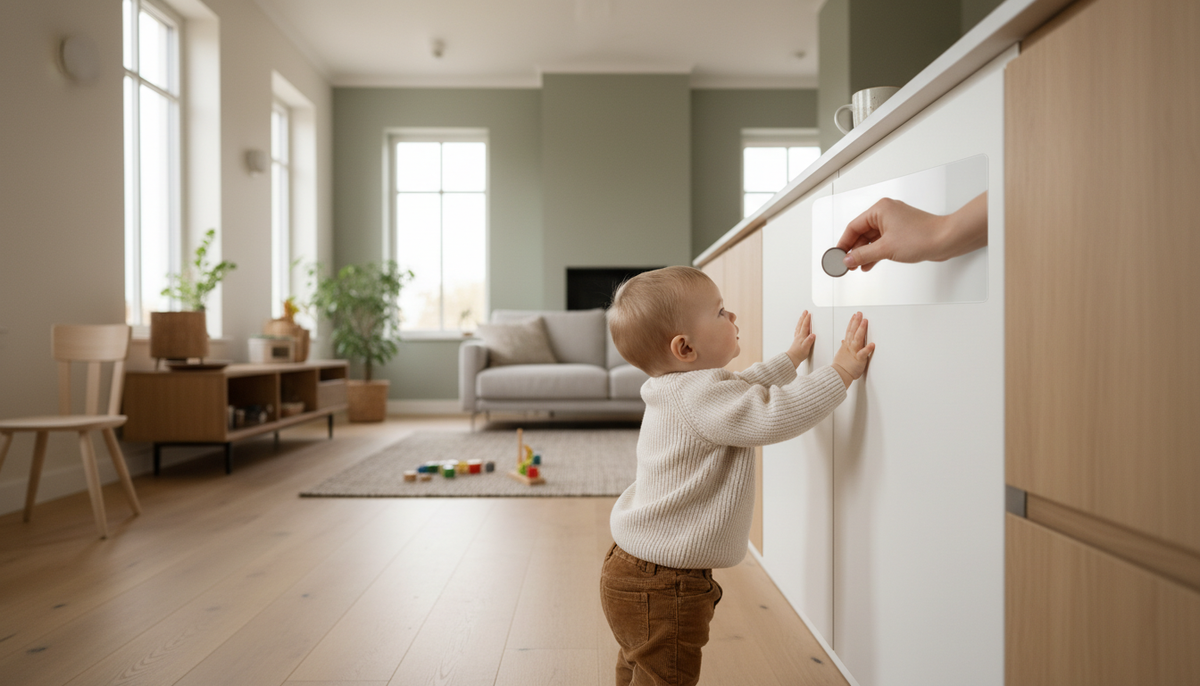

Magnetic Lock Gauss Ratings: What They Mean for Child Safety

Some magnetic cabinet locks list a gauss rating on the package or product page. Parents who see one tend to assume higher is better and move on. But the number alone tells you less than you’d think.
Understanding what gauss measures, and what it doesn’t, is the difference between a lock that holds through two years of toddler abuse and one that fails on a Tuesday afternoon while you’re answering the door.
What Gauss Measures
Gauss is the unit of magnetic field strength, named after the mathematician Carl Friedrich Gauss. It measures the intensity of the magnetic field produced between two magnet components. In cabinet lock terms, it describes how strongly the lock’s internal magnet is attracted to its strike plate when the cabinet door is closed.
One gauss equals one-tenth of a millitesla (mT). No gauss number on its own tells you whether a lock will hold against a persistent toddler. The cabinet-lock safety standard covered below, ASTM F3492–21, sets its performance bar as an average breaking strength in pounds.
But here’s what gauss doesn’t tell you: how much force in pounds or newtons a child needs to apply to open the lock. That depends on gauss rating plus the surface area of contact between the two magnets. Two locks rated at 900 gauss can perform very differently if one uses a larger strike plate. More contact area means more total holding force, even at identical field strength. This is why you can’t shop by gauss rating alone.
How Testing Standards Work
ASTM F3492–21 is the voluntary consumer safety standard that applies to cabinet locks and latches in the U.S. It was developed by ASTM subcommittee F15.76; ASTM’s announcement says the work responded to incident data compiled by the CPSC. The standard covers interior-mounted child-safety latches designed to restrict access for children under 48 months.
Critically, ASTM F3492–21 does not test gauss directly. It tests force. Locks that meet ASTM F3492–21 must withstand an average breaking force of at least 45.3 lbs across a 30-sample test. That’s the benchmark: not field strength, but the actual mechanical force required to defeat the lock assembly under standardized conditions.
This distinction matters. A lock can have an impressive gauss rating and still fail safety testing if the mechanical design is poor. The magnet might be positioned too close to the pivot point of the door, reducing leverage. The strike plate might be undersized. The latch mechanism itself might release under twisting or lateral force even when it resists direct pulling. A one-time lab result also can’t tell you how a lock holds up after months of daily opening and closing.
In my experience testing six different magnetic locks, one product had the highest gauss rating of the group and still felt noticeably less secure than two mid-range competitors. The strike plate was smaller, and the magnet was positioned in a way that let the door flex slightly before the lock engaged fully. Gauss was doing its job. The design wasn’t.


Why Magnetic Locks Beat the Alternatives for Young Children
Magnetic locks have practical advantages over key or combination locks for households with young children. Key locks introduce a choking hazard every time a key is misplaced, which in a house with a toddler is frequently. Combination locks require fine motor skills and memory that children under 5 don’t have, but neither do sleep-deprived parents at 6 a.m.
Magnetic locks eliminate both problems. The key is a handheld magnetic wand that adults keep out of reach. There are no small parts to lose, no sequences to remember, and no mechanism a toddler can manipulate through patience and observation.
The stakes are real. According to the AAP, about 3 million people are exposed to a poisonous substance every year, and many are children under 5. In 2024, household cleaning substances topped the list of substances kids under 6 got into, accounting for 10.1% of all pediatric poison center cases, per America’s Poison Centers. The under-sink cabinet is where most of those products live.
In my experience, my younger daughter once emptied the under-sink cabinet in the time it took me to answer the doorbell. She was 22 months old. The cabinet had a spring-loaded latch that I had considered adequate. I replaced it with a screw-mounted magnetic lock that afternoon.
Screw-Mounted vs. Adhesive: A Real Difference
Adhesive-mounted magnetic locks are more vulnerable to failure than screw-mounted versions. Vibration, temperature cycling, and humidity all weaken adhesive bonds over time. In a kitchen cabinet under a sink, where humidity spikes every time the dishwasher runs, adhesive failure is a matter of when, not if.
Screw installation takes a drill and a little time. It is the more durable choice for any cabinet storing chemicals, medications, or sharp objects. I use adhesive locks only in low-stakes locations: a cabinet storing extra paper towels, a drawer with plastic containers. Anything hazardous gets screws.
The 2012 CPSC recall of 900,000 Safety 1st Push 'N Snap cabinet locks is worth knowing. After 140 children defeated the locks, three reached toxic cleaning products. That recall involved a push-button mechanism, not magnetic locks specifically, but it illustrates what happens when a locking mechanism fails to meet the actual force and persistence of a determined toddler. It’s a reminder that how secure a lock feels and how secure it is are two different things.
How Magnetic Locks Lose Strength Over Time
Magnets are not permanent in the colloquial sense. Thermal cycling, meaning repeated exposure to heat and cold, gradually reduces magnetic field strength. So does humidity, particularly if it causes surface corrosion on the magnet or strike plate. Repeated mechanical stress from opening and closing cycles compounds this.
A lock that leaves the factory strong may hold less firmly after a couple of years in a kitchen cabinet. You won’t see a number on the lock telling you this. What you will notice, if you’re paying attention, is that the lock feels less snappy when it engages, or that the cabinet door swings open with less resistance than it used to.
Inspect magnetic locks quarterly. Run your hand across the magnet surface and strike plate looking for corrosion, which appears as rust-colored streaking or pitting. Try opening the lock with one hand while the cabinet is closed. If it opens with a light one-handed pull, the lock is no longer providing adequate protection against a persistent toddler. Replace it.
In my experience, my older daughter defeated an adhesive strap lock at 26 months, which is what sent me down the rabbit hole of understanding how these products work. She didn’t pry it open. She pulled the adhesive pad away from the cabinet surface, which left the lock intact but detached from the door. The gauss rating on that product was fine. The installation method was the failure.
Magnetic Lock Maintenance Checklist
Magnetic Locks and Surface Compatibility
Magnetic locks work best when the strike plate mounts to a metal or ferrous surface. On wood or plastic cabinets, which describes most residential kitchen cabinetry, the lock relies on a metal strike plate screwed into the cabinet interior. If that plate is misaligned even slightly, the magnet won’t seat fully against it, and the effective holding force drops.
Cabinet door warping is a related problem. Wood doors expand and contract with seasonal humidity changes. A lock that was perfectly aligned in October may be misaligned by March. If your cabinet door has developed a gap at the corner or doesn’t close flush, check whether the magnetic lock is still engaging fully before assuming it’s still working.
When installing on wood cabinets, use the alignment template that comes with the lock. If the lock didn’t include one, make your own with a piece of tape and a marker. Even slight misalignment can reduce holding force noticeably.
Defense in Depth: Why One Lock Isn’t Enough
A magnetic lock is a strong first line of protection. It shouldn’t be the only one. Hazardous products stored at toddler height are still hazardous if the lock fails, if the wand is left within reach, or if the lock was never installed correctly in the first place.
The practical approach is layered. Use magnetic locks on cabinets storing cleaning products, medications, and sharp objects. Move the most dangerous items, concentrated bleach, drain cleaner, anything caustic, to upper shelves or a locked storage area that requires a step stool to reach. Add a secondary spring latch on cabinets you’re most concerned about. No single mechanism is perfect. Under 16 CFR 1700.15 (poison-prevention packaging), federally child-resistant packaging only has to keep 80–85% of test-panel children (ages 42–51 months) out. Packaging and locks both have failure rates. Layering reduces the probability that all your defenses fail simultaneously.
Check every magnetic lock in your home quarterly. Replace any that show corrosion, feel weaker than they did, or have adhesive mounting that’s starting to lift. A lower-rated lock that’s properly installed, screw-mounted, and inspected regularly is a better bet than a higher-rated lock on failing adhesive.